Sunday, November 12, 2017

Doctrine and Covenants Section 97 Timeline


Background. 

Joseph Smith is in Kirtland, Ohio.  About 1000 Saints are in Jackson County, Missouri 800 miles away.  The members moved to Missouri because it had been promised to them that this would be Zion.

Things are about to get really bad....

July 20th, 


Mob violence erupts in Independence. Mobbers destroy W. W. Phelps’s printing office and scatter pages of the Book of Commandments. Bishop Edward Partridge and Charles Allen are tarred and feathered. 


Source


July 23rd


The mob appeared again on 23 July with rifles, pistols, whips, and clubs. They searched for Church leaders, cursing and profaning as they went. They set fire to haystacks and grain fields and destroyed several homes, barns, and businesses. The mob eventually confronted six leaders of the Church who, seeing the property and lives of the Saints in jeopardy, offered their lives as a ransom. 


Source 

They were forced to sign an agreement to leave Jackson County. 

August 2nd (Not on July 20th or 23rd)


Joseph is 800 miles away but the Lord can see everything and sees the suffering of his Saints in Missouri.  So he gives Joseph Smith a revelation.  What does it tell the Prophet about those saints in Missouri?  

Revelation given through Joseph Smith the Prophet, at Kirtland, Ohio, August 2nd, 1833.


Doctrine and Covenants 97

My paraphrasing-  

Your school is good, 

build a temple, 

pay your tithing, 

it will all be OK. .... if you keep the commandments.

October 31

How it ended

Determined to settle the matter decisively, the old settlers mobilized to drive the Mormons out. Renewed violence began on October 31, 1833, with an attack on the Whitmer Branch a few miles west of the Big Blue River, near Independence. The mob demolished houses, whipped the men, and terrorized the women and children. For a week, attacks, beatings, and depredations against the Saints continued. 


Full Text of Section 97


Section 97

Revelation given through Joseph Smith the Prophet, at Kirtland, Ohio, August 2, 1833. This revelation deals particularly with the affairs of the Saints in Zion, Jackson County, Missouri, in response to the Prophet’s inquiry of the Lord for information. Members of the Church in Missouri were at this time subjected to severe persecution and, on July 23, 1833, had been forced to sign an agreement to leave Jackson County.
1–2, Many of the Saints in Zion (Jackson County, Missouri) are blessed for their faithfulness; 3–5, Parley P. Pratt is commended for his labors in the school in Zion; 6–9, Those who observe their covenants are accepted by the Lord; 10–17, A house is to be built in Zion in which the pure in heart will see God; 18–21, Zion is the pure in heart; 22–28, Zion will escape the Lord’s scourge if she is faithful.
1 Verily I say unto you my friends, I speak unto you with my voice, even the voice of my Spirit, that I may show unto you my will concerning your brethren in the land of Zion, many of whom are truly humble and are seeking diligently to learn wisdom and to find truth.
2 Verily, verily I say unto you, blessed are such, for they shall obtain; for I, the Lord, show mercy unto all the meek, and upon all whomsoever I will, that I may be justified when I shall bring them unto judgment.
3 Behold, I say unto you, concerning the school in Zion, I, the Lord, am well pleased that there should be a school in Zion, and also with my servant Parley P. Pratt, for he abideth in me.
4 And inasmuch as he continueth to abide in me he shall continue to preside over the school in the land of Zion until I shall give unto him other commandments.
5 And I will bless him with a multiplicity of blessings, in expounding all scriptures and mysteries to the edification of the school, and of the church in Zion.
6 And to the residue of the school, I, the Lord, am willing to show mercy; nevertheless, there are those that must needs be chastened, and their works shall be made known.
7 The ax is laid at the root of the trees; and every tree that bringeth not forth good fruit shall be hewn down and cast into the fire. I, the Lord, have spoken it.
8 Verily I say unto you, all among them who know their hearts are honest, and are broken, and their spirits contrite, and are willing to observe their covenants by sacrifice—yea, every sacrifice which I, the Lord, shall command—they are accepted of me.
9 For I, the Lord, will cause them to bring forth as a very fruitful tree which is planted in a goodly land, by a pure stream, that yieldeth much precious fruit.
10 Verily I say unto you, that it is my will that a houseshould be built unto me in the land of Zion, like unto the pattern which I have given you.
11 Yea, let it be built speedily, by the tithing of my people.
12 Behold, this is the tithing and the sacrifice which I, the Lord, require at their hands, that there may be a housebuilt unto me for the salvation of Zion—
13 For a place of thanksgiving for all saints, and for a place of instruction for all those who are called to the work of the ministry in all their several callings and offices;
14 That they may be perfected in the understanding of their ministry, in theory, in principle, and in doctrine, in all things pertaining to the kingdom of God on the earth, the keys of which kingdom have been conferred upon you.
15 And inasmuch as my people build a house unto me in the name of the Lord, and do not suffer any unclean thingto come into it, that it be not defiled, my glory shall rest upon it;
16 Yea, and my presence shall be there, for I will come into it, and all the pure in heart that shall come into it shall see God.
17 But if it be defiled I will not come into it, and my glory shall not be there; for I will not come into unholy temples.

18 And, now, behold, if Zion do these things she shall prosper, and spread herself and become very glorious, very great, and very terrible.
19 And the nations of the earth shall honor her, and shall say: Surely Zion is the city of our God, and surely Zion cannot fall, neither be moved out of her place, for God is there, and the hand of the Lord is there;
20 And he hath sworn by the power of his might to be her salvation and her high tower.
21 Therefore, verily, thus saith the Lord, let Zion rejoice, for this is Zion—the pure in heart; therefore, let Zion rejoice, while all the wicked shall mourn.
22 For behold, and lo, vengeance cometh speedily upon the ungodly as the whirlwind; and who shall escape it?
23 The Lord’s scourge shall pass over by night and by day, and the report thereof shall vex all people; yea, it shall not be stayed until the Lord come;
24 For the indignation of the Lord is kindled against their abominations and all their wicked works.
25 Nevertheless, Zion shall escape if she observe to do all things whatsoever I have commanded her.
26 But if she observe not to do whatsoever I have commanded her, I will visit her according to all her works, with sore affliction, with pestilence, with plague, with sword, with vengeance, with devouring fire.
27 Nevertheless, let it be read this once to her ears, that I, the Lord, have accepted of her offering; and if she sin no more none of these things shall come upon her;
28 And I will bless her with blessings, and multiply a multiplicity of blessings upon her, and upon her generations forever and ever, saith the Lord your God. Amen.


Thursday, November 9, 2017

Many people were healed through fasting and prayer and 600 PEOPLE DIED

Lesson from LDS Church History Primary Manual:  600 People died in the winter of 1846, but many were healed through fasting and prayer.

I don't even know how to comment on this.  If it wasn't so tragic, the paragraph would feel like a joke.  


Background story:   In 1846, as the Mormons were fleeing Illinois after the murder of the Prophet Joseph Smith, around 8000 pioneers spent the winter near what is now Omaha, Nebraska.  Malaria, bitter cold and starvation killed more that 600 people.  

.... when you are starving, does that count as fasting to God?  Or does it only count when you have food in the fridge and you choose to not eat?  


The Mormon Myth of 1000 Young Indian Braves

The Mormon Myth of the 1000 Indian Braves

Is it morally acceptable to teach something that is false if it helps children believe in a religion?  


The current Primary Manual has the following story.  
link

Tell in your own words the following story:
"A group of Latter-day Saint pioneers, led by Brigham Young, were near the Rocky Mountains. One night they camped in a small valley. After supper they built a big bonfire. They sang and danced around the bonfire to help them forget their fears and worries.
Before they went to bed in their wagons, leaving a single guard on duty, they sang “Come, Come, Ye Saints,” a song they used to encourage each other and show their dedication to the Lord.
That night there were a thousand unfriendly Indians hiding around the camp, ready to attack the pioneers. But after the Indians heard the pioneers sing “Come, Come, Ye Saints,” they were unable to attack. They knew the Great Spirit (their name for Heavenly Father) was watching over the pioneers, so they got on their horses and rode away, leaving the pioneers alone.
Some time later, the man who had been chief over the group of Indians told this story to some Latter-day Saint missionaries. When he finished the story, he took out a violin and began to play “Come, Come, Ye Saints.” He explained to the missionaries, “This is your song, but it is my song, too. I play it every night before I go to bed. It brings the Great Spirit here to me and makes me and my people calm and happy.”
(See Lucile C. Reading, “Song of the Pioneers,” Children’s Friend, July 1965, p. 37.)

The Manual quotes a story from the Children's Friend 1965.  

The Children's Friend version of the story quotes a 1958 book called A Century of Singing.  Which is about the Mormon Tabernacle Choir. The book version of the story adds two more layers of sources.  It says that the story was told to four missionaries told the son of the Chief of the 1000 Indian Braves.  

So let's review the source trail....

Ten Other Issues With the Story:
See other versions of story below.

#1 - There is no evidence that the 1847 / 48 Mormon Pioneers sang, "Come, Come Ye Saints". 
(Source)

#2 - 1000 Young braves  on 1000 horses would take up almost 2 miles if spaced every ten feet. 

#3 - The 1000 Indians managed to come into the valley, hide behind rocks and trees and then leave without being noticed by the Mormons.

#4 - The chief was able to give a signal in the dark that 1000 Indians could perceive but the Mormons did not. 

#5 - In one version of the story, the teller also plays the tune on the violin.  

#6 - 1000 Indians in one place was extremely rare and nearly never seen in a war party outside the open planes.  Think of the amount of food, supplies, horse feed that a camp of 1000 would need.  Additional Reading

#7 - Why would mid 19th century Indians claim a song in English about pioneers as their song?

#8 - Does this feel a bit too much like the story of the 2000 Lamanite Warriors from the Book of Mormon?  

#9 - How many Indian Villages in 1840's Wyoming would it take to recruit 1000 YOUNG Braves?

#10 - There are no stories from Mormon History, Oregon Trail History or California Gold Rush History where a party of 1000 Warriors attacked a wagon train.  They just didn't travel in groups that big.  


Things to Think About

#1 - Why does the LDS Church teach its children a 4th or 5th hand story as fact, but reject nearly every other source of history outside its own correlated material?  

#2 - Is it OK to teach a story that is false if it makes children believe in the message?  

#3 - Would it be OK for the missionaries to teach the First Vision or Book of Mormon stories to millions if they are also false, if they help people believe the message?

# 4 - Is this story racist?  Does it create a stereotype of blood thirsty 19th century Native Americans? 


It is NOT morally acceptable to teach something False, while presenting it as fact.  

_______________________________________________________________________________

_______________________________________________________________________________
_______________________________________________________________________________


The John Moyle Story from the same Lesson Manual


Other Sources and Materials:

LDS Living Article about the Story
Ms. Fish Blog Post about Story
Stand a Little Taller Blog Post

Different Versions of the Same Story


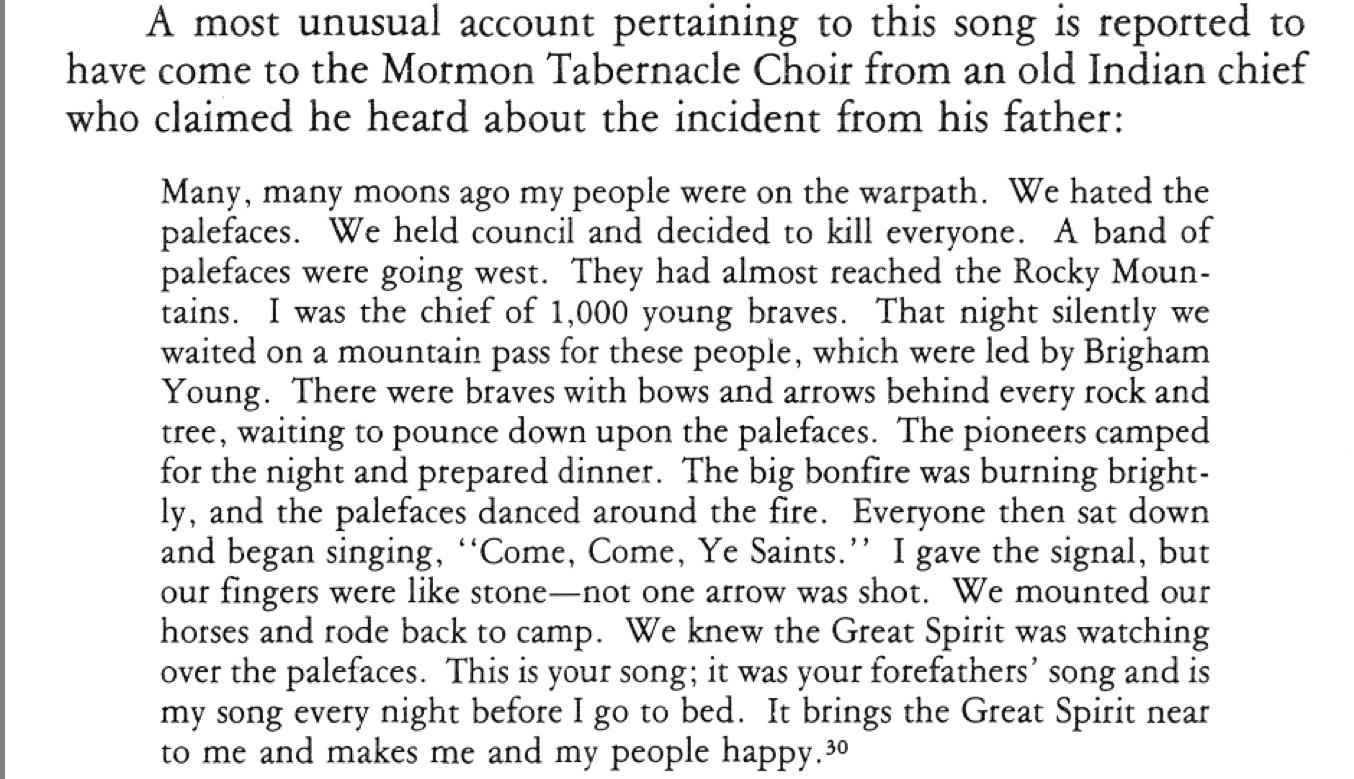
The Century of Singing Version:


A most unusual account pertaining to this song is reported to have come to the Mormon Tabernacle Choir from an old Indian chief who claimed he heard about the incident from his father:

Many, many moons ago my people were on the warpath. We hated the palefaces. We held council and decided to kill everyone. A band of palefaces were going west. They had almost reached the Rocky Mountains. I was the chief of 1,000 young braves. That night silently we waited on a mountain pass for these people, which were led by Brigham Young. There were braves with bows and arrows behind every rock and tree, waiting to pounce down upon the palefaces. The pioneers camped for the night and prepared dinner. The big bonfire was burning brightly, and the palefaces danced around the fire. Everyone then sat down and began singing, "Come, Come, Ye Saints." I gave the signal, but our fingers were like stone—not one arrow was shot. We mounted our horses and rode back to camp. We knew the Great Spirit was watching over the palefaces. This is your song; it was your forefathers' song and is my song every night before I go to bed. It brings the Great Spirit near to me and makes me and my people happy.


IMG_1290.PNG


IMG_1292.PNG


Thursday, October 26, 2017

The Mormon Church doesn't give a sh*t about families..

From Lesson for Mormon Children ages 8 - 11


The story is horrific, but by telling this story in 2017 in the Primary manual it implies that these kid's Daddy's could be called away from their families at any time.  The lesson never says, "We don't do this any more". 

Lesson Source

Tuesday, October 24, 2017

John Rowe Moyle the Stone Cutter

John Moyle Stone Cutter Story


From the Primary Manual #5 Lesson #44:

"John Moyle was one of the stonemasons who worked on the temple. Every Monday morning he walked twenty miles from his home to the temple site. He worked on the temple all week, and then on Friday he walked twenty miles home to take care of his farm. Brother Moyle was injured in an accident and his leg had to be removed, but he made himself a wooden leg. He practiced walking on the leg until he could endure the pain it caused. Then he walked on his wooden leg to Salt Lake City to continue working on the temple. He carved the words Holiness to the Lord on the east side of the temple."      (Underlines and highlighting added)

Commentary:  
There is no question that John Moyle was a valiant pioneer, a hard worker and a gifted stone cutter.  
The problem I have is that the LDS Church cannot help but twist a great story and make into a lie.  Either that, or they need to check their facts. 

20 Miles or 26.3 Miles?
The lesson says that Moyle walked 20 miles to get to the temple.  Walking 20 minutes / mile that would take 6 hours.  OK Maybe.  

A Deseret News Article says Moyle walked 22 miles, leaving at 2:00 AM to arrive at work at 8:00 AM.  If it is 22 miles in  6 hours that is about 16 minutes and 20 seconds per mile.  OK....  Walking pace for someone super fit.  

But the 22 miles is "As the Crow Flies". The reality is that using today's roads, the shortest distance to the Salt Lake Temple it is 26.3 miles.  Just more than a marathon.  When you look at the photo above showing the Draper Temple, you realize why you can't to a straight path.  Alpine is on the back side of that mountain.  The area is super mountainous, and today is a mountain biking haven.  See image at the bottom.

So why does the lesson manual say 20 miles when it's really 26.3 miles?  20 miles is perhaps digestible over mountain roads, across creeks, over dusty paths, but 26.3 miles is not.  They are avoiding investigation.  26.3 miles in 6 hours would be 13 minutes 30 seconds / mile.  This for a 50 - 70 year old, who then would work a very physical 8 hour day.  

Wooden Leg Story
Again, there is no question that John Moyle was a tough guy.  A classic pioneer in every way, but the lesson tells about his leg being broken and then implies that he kept working in the same way he always had.  

A talk by Elder Dieter Uchtdorf in 2008 said, " In spite of the crude surgery, the leg started to heal. Once John could sit up in bed, he began carving a wooden leg with an ingenious joint that served as an ankle to an artificial foot. Walking on this device was extremely painful, but John did not give up, building up his endurance until he could make the 22-mile (35-km) journey to the Salt Lake Temple each week, where he continued his work. "  according to this article he was 77 years old at the time.  

Is Uchtdorf really saying that at age 77 that Brother Moyle made the 22 miles (26.3 mile?) journey to the temple on a crude wooden leg?

The Timeline
John Moyle was born in 1808.  He turned 77 years old in 1885.  Not only is it extremely unlikely that a 77 year old with a crude peg leg could walk 26 miles, it is even stranger that nobody thought to loan him a horse or buggy or that the LDS church didn't provide transportation for him.  By 1872 (15 years before his peg-leg adventure) there was a railroad going from Lehi to Salt Lake City.  Source  Why didn't he walk the 8 miles from Alpine to Lehi and catch the train?
Conclusion
John Moyle seems like a great man.  He did so much, provided for his family and left a great legacy of faith.  Unfortunately embellishments have made his story seem like a myth and diminish his greatness upon inspection. 

Edit:  The Wheat and Tares site did some additional research on this work and for the most part confirmed my conclusions.  You can read their work here.  

From Their Work:

That Utah Enquirer blurb about him crushing his leg with a log was published June 12, 1888. The Deseret News article was published June 27, 1888.Unless this guy had a habit of crushing his legs, he wouldn’t have started wearing a prosthetic limb until much later in life, at the age of 80. And since he passed away in February 1889, he only got to wear that wooden leg a maximum of 8 months. Not a lot of time to recover and make a whole bunch of weekly trips to Salt Lake. 

[...] 

At the time the “Holiness to the Lord” inscription was installed, Moyle was still about three years away from losing his leg. (In case you’re wondering, the completion date was engraved on the inscription stone just prior to the dedication in 1893, four years after Moyle died.) 

-Wheat and Tares 


More Sources

Wikipedia - John Moyle

Great - Grandson - Henry D. Moyle

Deseret News - John Moyle


Primary Lesson # 44 - S.L. Temple

Trail Map Between Draper and Alpine

LDS.org - Temple Walk Challenge

Great Story - Wise Question


I sent this letter to The Church History Department and got this response:

This response is in relation to CH80355
The question or suggestion was:

I have questions about the provenance for the story of John Rowe Moyle the stonecutter found in the current Church History Primary Manual as well as a 2008 talk by Elder Uchtdorf. As it is found in the primary manual lesson #44 it implies that Mr. Moyle walked between 20 - 27 miles many times from Alpine, Utah to Salt Lake City to work on the temple, and then after a leg amputation, he continued to make the same commute week after week.

For multiple reasons I found the story false as written. It is unfortunate that a great pioneer like Mr. Moyle has his life made into folklore rather than fact, and that it is printed in a document called "Church History".

Where can I go, or who can I contact to discuss this issue, and am I wrong in trying to point our errors in the Church History Manual?

My father and john Parry built in 1869 the old Walker Brothers 
Building on South Main. While erecting that building, Father had 
to go to Alpine to help my grandfather, John Rowe Moyle. He had 
injured his leg and the favorably known physician of Provo, Dr. 
Pike, had done his best to save the leg but gangrene had set in. 
Consequently, Father took Mother, me, and Dr. Ormsby, the 
leading surgeon in Utah, to Alpine to amputate Grandfather’s leg 
below the knee. 
From:  Moyle Biography


Once when he was home on the weekend, one of his cows bolted during milking and kicked Brother Moyle in the leg, shattering the bone just below the knee. With no better medical help than they had in such rural circumstances, his family and friends took a door off the hinges and strapped him onto that makeshift operating table. They then took the bucksaw they had been using to cut branches from a nearby tree and amputated his leg just a few inches below the knee. When against all medical likelihood the leg finally started to heal, Brother Moyle took a piece of wood and carved an artificial leg. First he walked in the house. Then he walked around the yard. Finally he ventured out about his property. When he felt he could stand the pain, he strapped on his leg, walked the 22 miles to the Salt Lake Temple, climbed the scaffolding, and with a chisel in his hand hammered out the declaration “Holiness to the Lord.”8

From Talk by Jeffery Holland


The Following Quote called "Family Traditions" by Theodore Burton


The second story involved his work on the Temple. On one of these occasions when he had returned home for the weekend, he was taking care of milking his cow when, perhaps impatiently or with his hands too cold, or being too rough, he hurt the cow and she kicked him and broke his leg. It was a nasty fracture of a compound nature and the bone stuck through the flesh. In those days there was not much that could be done for people in the way of anesthesia even though they decided the only thing they would do under the circumstances was to cut off his leg. The story goes that they gave him a big drink of whiskey and a leaden bullet to bite his teeth on, tied him to a door and then with a bucksaw, 203 sawed off his leg, bound the flesh over the stump and allowed it to heal. It is a wonder he didn't die of infection, but the Lord blessed him and the would healed over. while it was healing, he got himself a piece of wood and carved out a peg-leg. He fastened some leather to the top of the wood, padded it and fitted it to his leg. As soon as the wound had healed sufficiently, he walked around the farm on that stump until he was able to stand the pain and had formed a callous over the stump. when it had healed, he walked into Salt Lake as was his custom to take up his work, for he had been called as a work missionary on the Temple. And there, the story goes, he climbed up the scaffolding on the east side of the Temple and carved "Holiness to the Lord," as his contribution to the Temple building. Mother told me that great grandfather was a very skilled mason, much more skilled than some and hence grandfather, who was then superintendent of the masonry work on the Temple, asked him to carve the stones which made the spiral stone staircases in the corners of the Temple. This required meticulous cutting and couldn't be trusted to ordinary stone cutters. Mother said this was his major contribution to the construction of the Salt Lake Temple. These are the stories, as I remember them, from family tradition.


Saturday, October 7, 2017

Henry Eyring Mocks those who left the Church in 1837 - 38.

In Henry Eyring's General Conference talk in October 2017 he mocked those leaders who declared Joseph Smith a "Fallen Prophet".  Before the end of 1838 all the following significant leaders had left: (Eyring's Talk)

Oliver Cowdery, Martin Harris, David, Peter, John Whitmer, Hiram Page, Thomas Marsh, William McLellin, Luke Johnson, their families and many more.  

Here is a list of some of the "insignificant reasons" that they may have left. 


Real Reasons - Spilled milk, lazy, wanting to sin, misspelled names, offended.